Trajectory Work Capabilities Services Background Get in touch
Open to new roles and freelance projects

I build AI systems that reach production — and I measure whether they actually work.

AI Engineer and full-stack developer based in Bochum, Germany. I've shipped LLM systems into production, evaluated 27 language models for my published research, and I build complete products end to end.

Lionel Richy Panlap
27

Language models evaluated in my master's research, published on arXiv.

2M

Transaction records analysed at ALDI SÜD to find what drives customer behaviour.

70%

Processing time removed from a data-quality pipeline through content fingerprinting.

300+

Businesses whose data quality and web presence run on software I designed.

How the stack was built

Each capability arrived because a project needed it. Nothing here is theoretical — the bar starts the year I first shipped something with it.

201720192021202320252026
Systems & infrastructureNetworks, Windows Server, Active Directory
2017
Data & analyticsPython, Pandas, statistical modelling, Power BI
2022
Deep learning & researchPyTorch, model evaluation, published study
2022
LLMs in productionFastAPI, structured outputs, Temporal, observability
2025
Agents & orchestrationLangChain, MCP, multi-agent pipelines, n8n
2026
Product & architectureNext.js, Supabase, security hardening, CI/CD
2026

Solid fill marks depth of use; the lighter band marks that the skill stays in active rotation.

Selected work

Three products where I owned the architecture, the AI layer and the shipping. Two are client-facing, one runs inside an organisation.

Live SaaS 2026

NuptialFlow

A wedding platform for couples who plan across families and continents. Guests, budget, committees, seating and schedule live in one place — and each committee only ever sees its own data.

  • Access control enforced in PostgreSQL itself, not just in the interface — a catering lead cannot read the budget, by design.
  • AI seating suggestions from Google Gemini, always proposed to a human before anything is written.
  • Payments confirmed through Stripe webhooks server-side; no key ever reaches the browser.
Next.js 14TypeScriptSupabasePostgreSQL RLSGeminiStripeVercel
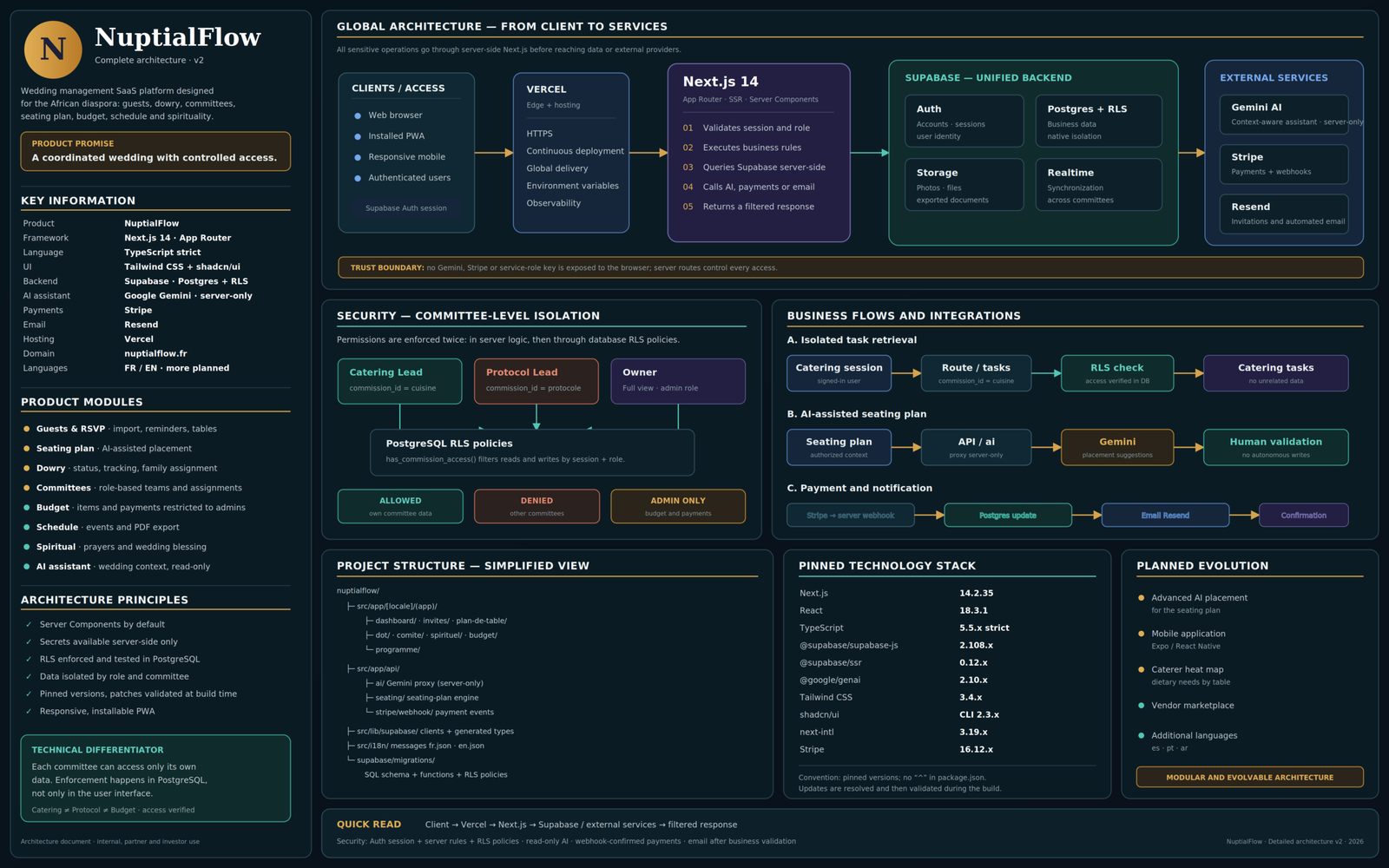
NuptialFlow architecture diagram
System architecture — client to services, with the trust boundary marked.
In development Multi-agent AI 2026

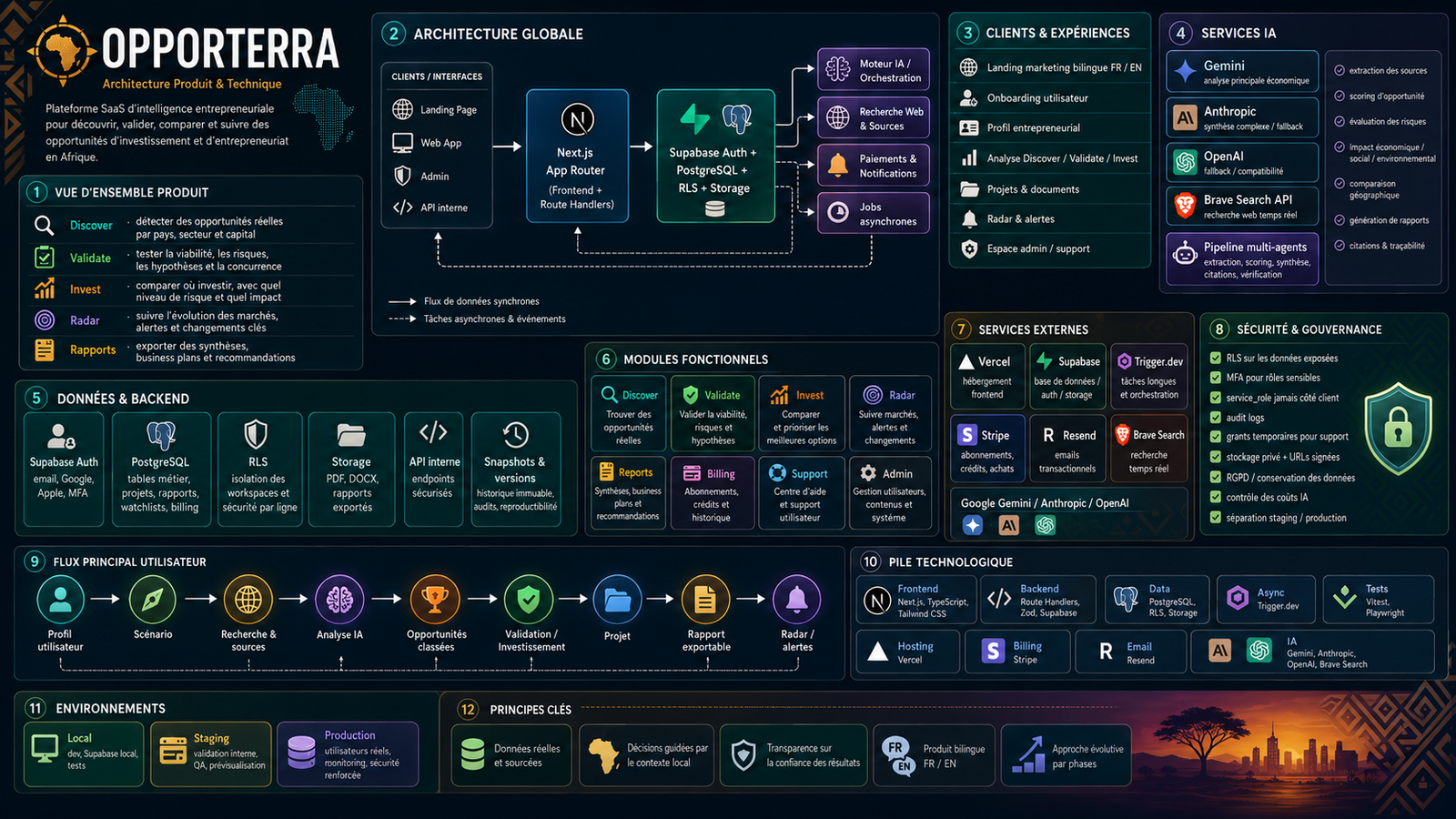
Opporterra

An intelligence platform for people investing or building in Africa. It finds real opportunities by country, sector and capital, then tests them against risk and competition.

  • A pipeline of specialised agents: one extracts sources, one scores the opportunity, one weighs risk, one writes the report.
  • Three model providers with fallback, plus live web search, so an answer is never left to a single system.
  • Every claim carries its citation — the point is traceable analysis, not confident-sounding text.
Next.jsGeminiAnthropicOpenAIBrave SearchSupabaseTrigger.dev
Opporterra product and technical architecture
Product and technical architecture — from user profile to exportable report.
Internal tool Data quality 2026

DataCare

Built for Mwemba, a directory of African restaurants, barbershops and grocers across Europe. It keeps the data on 300+ businesses trustworthy, and gives the ones without a website a real one.

  • Fifteen categories of data problems caught automatically — missing fields, near-duplicates found by fuzzy name and location matching, broken encoding, malformed phone numbers and URLs.
  • Content is fingerprinted, so unchanged records are never re-analysed. That alone removed about 70% of the processing time on repeat runs.
  • The language model is called only for genuinely ambiguous cases. Everything else stays deterministic, which keeps results reproducible and costs flat.
  • A four-stage generator writes each business a complete site: model-written copy, the shop's own validated photos, a colour palette derived from its name, assembled through templating.
  • Hardened against cross-site scripting and server-side request forgery, and deployed through the existing Jenkins and Kubernetes setup.
PythonGroqGPT-4.1-miniJinja2JenkinsKubernetes

What I actually do

Four areas, each backed by work that shipped rather than a course I once took.

Getting language models into production

The hard part is never the demo. It's what happens under load, when the model returns something unexpected, or when the bill arrives. I design for those.

Structured outputsRAGPrompt engineeringFine-tuningLangChainMCP

Knowing whether the AI is any good

I evaluated 27 models for my thesis and learned that automatic scores alone will mislead you. I set up measurement that reflects what users actually experience.

BLEUROUGEBERTScoreG-EvalUser studiesLangfuse

Backends that hold up

APIs, data pipelines and the unglamorous parts around them — retries, timeouts, migrations, tests that catch things before users do.

PythonFastAPISQLAlchemyTemporalPytestDockerSQL

Products, front to back

Interface, data model, payments, access control, deployment. I've shipped the whole chain, which makes me a better engineer on any one part of it.

Next.jsTypeScriptReactSupabaseStripePostgreSQL RLS

Working together

Available for freelance projects alongside permanent roles. Every engagement starts with a call about the problem, not the technology.

Put AI into your product

You know where AI could help but not how to make it dependable. I take it from idea to something your users can rely on.

  • Assistants and chat grounded in your own documents
  • Agents that carry out multi-step work
  • Output validation so answers stay inside the rails
Scoped per project

Build the application

A web product built properly — the interface people see and the architecture that keeps it standing.

  • Web applications and internal tools
  • APIs, databases and integrations
  • Sites and portfolios that load fast
Scoped per project

Make sense of your data

Cleaning, analysis and reporting, so decisions rest on something firmer than instinct.

  • Data quality and automated cleanup
  • Analysis and machine learning models
  • Dashboards people will actually open
Scoped per project

Background

I started in server rooms in Cameroon and moved toward AI as the questions got more interesting.

  • Generative AI Developer, Retail AI GmbHFrankfurt. Shipped LLM-driven analysis workflows, owned the testing strategy.
  • M.Sc. Computer Science, Hochschule Ruhr WestDeep learning focus. Thesis graded 1.3 and published on arXiv.
  • Data Analyst intern, ALDI SÜDCustomer Knowledge Hub. Market basket analysis, segmentation, regional KPI modelling.
  • IT Systems Administrator, CameroonNetworks, servers and Active Directory in live business environments.
  • Microsoft Azure AI Fundamentals & Azure FundamentalsAI-102 in preparation. Also certified in MCP and PCEP Python.
  • DAAD scholarshipAwarded for the final stage of study in Germany.

Tell me what you're building

Whether it's a role you're hiring for or a project that needs a hand — write to me and I'll come back quickly.